Wednesday, 16 November 2011

Good Is//Benneton UnHate Campaign.


Another day, another brilliant campaign by the advertising team at Benetton.
For the company that is now far more famous for it's guerilla, and often outlandish marketing tactics than it's clothing range have made another winner with their 'UnHate' campaign, in which World Leaders embrace the love with a quick kiss. LOVE the political satire used (once again) by Benetton- always so edgy and contemporary. The Angela Merkel/Sarkozy design makes me hoot. 

Brilliant concept, imagery and print production utilised here- the editorial work on the photographs is really amazing. I aspire to create work like this.
Great feature below from design boom...

http://www.designboom.com/weblog/cat/8/view/17676/benetton-unhate-campaign-features-kissing-world-leaders.html


United colors of benetton advertisement featuring hu jintao, paramount leader of the people's republic of china, with barack obama, president of the USA


united colors of benetton has just unveiled its new 'unhate' advertising campaign in a handful,
of cities, featuring manipulated images that show unlikely pairings of international religious and
political leaders kissing one another.


the ad campaign supports the company's 'unhate foundation' think tank and arts research center,
designed to organize events and promote acts of intervention towards a more tolerant world.
as its first series of actions, benetton organized the hoisting of large posters and projection of digital
images of the controversial advertisements in public spaces in new york, milan, rome, tel aviv, and paris.


online, the organization's 'kiss wall' invites users from around the world to upload diptyched images
that mimic kissing duos, alongside a message of tolerance and 'unhate'.


'what does 'unhate' mean? 'un-hate. stop hating, if you were hating. unhate is a message that invites us
to consider that hate and love are not as far away from each other as we think. actually, the two opposing
sentiments are often in a delicate and unstable balance. our campaign promotes a shift in the balance
.'

- alessandro benetton, executive vice president


Ad featuring pope bendetto XVI with ahmed el tayyeb, imam of al-azhar mosque in cairo


North Korea's kim jong-ii and lee myung-bak, president of south korea


Israel prime minister benjamin netanyahu and palestinian president mahmoud abbas


German chancellor angela merkel and french president nicholas sarkozy


US president barack obama with venezuelan president hugo chavez


'guerrilla intervention' in milan, piazza duomo


'guerrilla intervention' in milan's piazza affari (milan stock exchange)


'guerrilla intervention' in new york's times square

What Is Design For Print?//Risography & Mimeography.


Stumbled upon two new printing methods today which seem really unique and fascinating. Throughout this module, I feel like I have learnt a great deal (and I hope it has been reflected!) and feel confident that I would like to pursue more print as I move on and push my design practice and professional development within my work.

RISOGRAPHY

Risograph is a high-speed digital printing system manufactured by the Riso Kagaku Corporation and designed mainly for high-volume photocopying and printing. Increasingly, Risograph machines have been commonly referred to as a RISO Printer-Duplicator, due to their common usage as a network printer as well as a stand-alone duplicator. When printing or copying multiple quantities (generally more than 20) of the same original, it is typically far less expensive per page than a conventional photocopier, laser printer, or inkjet printer. Printing historian Rick O'Connor has debated that the original, and thus correct, name for the device is RISSO and not RISO. This debate spawns from the notion that an extra 'S' is added because the inventor's wife found it more pleasing to the ears.

How a Risograph works

The underlying technology is very similar to a mimeograph. It brings together several processes which were previously carried out manually, for example using the Riso Print Gocco system or the Gestetner system.
The original is scanned through the machine and a master is created, by means of tiny heat spots on a thermal plate burning voids (corresponding to image areas) in a master sheet. This master is then wrapped around a drum and ink is forced through the voids in the master. The paper runs flat through the machine while the drum rotates at high speed to create each image on the paper.
This simple technology is highly reliable compared to a standard photocopier and can achieve both very high speeds (typically 130 pages per minute) and very low costs. A good lifespan for a risograph might involve making 100,000 masters and 5,000,000 copies.
The key master-making thermal head component is manufactured by Toshiba. Similar machines to Risographs are manufactured by Ricoh, Gestetner, Rex Rotary and Nashuatec. All these other brands are now owned by Ricoh.
Because the process involves real ink - like offset printing - and does not require heat to fix the image on the paper - like a photocopier or laser printer - the output from a risograph can be treated like any printed material. This means that sheets which have been through a risograph may happily go through a laser printer afterwards and vice-versa.
For schools, clubs, colleges, political campaigns and other short run print jobs, the Risograph bridges the gap between a standard photocopier (which is cheaper up to about 50 copies) and using a commercial printer (cheaper over about 10,000 copies).
Risographs have typically had interchangeable colour inks and drums allowing for printing in different colours or using spot colour in one print job. The Riso MZ series models have two ink drums allowing two colours to be printed in one pass.

MIMEOGRAPHY
http://en.wikipedia.org/wiki/Mimeograph

The stencil duplicator or mimeograph machine (often abbreviated to mimeo) is a low-cost printing press that works by forcing ink through a stencil onto paper.
Along with spirit duplicators and hectographs, mimeographs were for many decades used to print short-run office work, classroom materials, and church bulletins. They also were critical to the development of early fanzines because their low cost and availability enabled publication of amateur writings. These technologies began to be supplanted by photocopying and cheap offset printing in the late 1960s.
Although in mid-range quantities, mimeographs remain more economical and energy-efficient, easier-to-use photocopying and offset printing have replaced mimeography almost entirely in developed countries. Mimeograph machines continue to be used in developing countries because it is a simple, cheap, and robust technology. Many mimeographs can be hand-cranked, and thus require no electricity.

Origins

Thomas Edison received US patent 180,857 for "Autographic Printing" on August 8, 1876. The patent covered the electric pen, used for making the stencil, and the flatbed duplicating press. In 1880 Edison obtained a further patent, US 224,665: "Method of Preparing Autographic Stencils for Printing", which covered the making of stencils using a file plate, a grooved metal plate on which the stencil was placed which perforated the stencil when written on with a blunt metal stylus.
The word "mimeograph" was first used by Albert Blake Dick when he licensed Edison's patents in 1887.
Dick received Trademark Registration no. 0356815 for the term "Mimeograph" in the U.S. Patent Office. It is currently listed as a dead entry, but shows the A.B. Dick Company of Chicago as the owner of the name.
Over time, the term became generic and is now an example of a genericized trademark. ("Roneograph," also "Roneo machine," was another trademark used for mimeograph machines, the name being a contraction of Rotary Neostyle)
Others who worked concurrently on the development of stencil duplicating were Eugenio de Zaccato and David Gestetner, both in Britain. In Britain the machines were most often referred to as "duplicators", though the predominance of Gestetner and Roneo in the UK market meant that some people referred to the machine by one of those two manufacturers' names.
In 1891, Gestetner patented his Automatic Cyclostyle. This was one of the first rotary machines that retained the flatbed, which passed back and forth under inked rollers. This invention provided for more automated, faster reproductions since the pages were produced and moved by rollers instead of pressing one single sheet at a time.
By 1900, two primary types of mimeographs had come into use: a single-drum machine and a dual drum machine. The single-drum machine used a single drum for ink transfer to the stencil and the dual-drum machine used two drums and silk-screens to transfer the ink to the stencils. The single drum (example Roneo) machine could be easily used for multi color work by changing the drum - each of which contained ink of a different color. This was spot color for mastheads. Colors could not be mixed.
The mimeograph became popular because it was much cheaper than traditional print - there was no typesetting or skilled labor involved. One individual with a typewriter and the necessary equipment essentially became his own printing factory, which allowed for greater circulation of printed material.

Mimeography process

The image transfer medium is a stencil made from waxed mulberry paper. This flexible waxed sheet is backed by a sheet of stiff card stock, with the sheets bound at the top.
Once prepared, the stencil is wrapped around the ink-filled drum of the rotary machine. When a blank sheet of paper is drawn between the rotating drum and a pressure roller, ink is forced through the holes on the stencil onto the paper. Early flatbed machines used a kind of squeegee.

Preparing stencils

For printed copy, a stencil assemblage is placed in a typewriter. The typewriter ribbon has to be disabled so that the bare, sharp type element strikes the stencil directly. The impact of the type element displaces the wax, making the tissue paper permeable to the oil-based ink. This is called "cutting a stencil."
A variety of specialized styluses were used on the stencil to render lettering, illustrations, or other artistic features by hand against a textured plastic backing plate.
Mistakes can be corrected by brushing them out with a specially formulated correction fluid, and retyping once it has dried. ("Obliterine" was a popular brand of correction fluid in Australia and the United Kingdom.)
Stencils were also made with a thermal process, an infrared method similar to that used by early photocopiers. The common machine was called a Thermofax.
Another device, called an electrostencil machine, sometimes was used to make mimeo stencils from a typed or printed original. It worked by scanning the original on a rotating drum with a moving optical head and burning through the blank stencil with an electric spark in the places where the optical head detected ink. It was slow and filled the air with ozone and text produced from electrostencils was of lower resolution than that produced by typed stencils, although the process was good for reproducing illustrations. A skilled mimeo operator using an electrostencil and a very coarse halftone screen could make acceptable printed copies of a photograph.
During the declining years of the mimeograph, some people made stencils with early computers and dot-matrix impact printers.

Limitations

Unlike spirit duplicators (where the only ink available is depleted from the master image), mimeograph technology works by forcing a replenishable supply of ink through the stencil master. In theory, the mimeograph process could be continued indefinitely, especially if a durable stencil master were used (e.g. a thin metal foil). In practice, most low-cost mimeo stencils gradually wear out over the course of producing several hundred copies. Typically the stencil deteriorates gradually, producing a characteristic degraded image quality until the stencil tears, abruptly ending the print run. If further copies are desired at this point, there is no choice but to make up another stencil from scratch.
Often, the stencil material covering the interiors of closed letterforms (e.g. "a", "b", "d", "e", "g", etc.) would fall away during continued printing, causing ink-filled letters in the resulting copies. The stencil would gradually stretch, starting near the top where the mechanical forces were greatest, causing a characteristic "mid-line sag" in the textual lines of the copies, that would progress until the stencil failed completely. The Gestetner Company (and others) devised various methods to make mimeo stencils last longer in use.
Compared to spirit duplication, mimeography produced a darker, more legible image. Spirit duplicated images were usually tinted a light purple or lavender. which gradually became lighter and fainter in color over the course of some dozens of copies. Mimeography was often considered "the next step up" in quality, capable of producing hundreds of copies. Print runs beyond that level were usually produced by professional printers, or as the technology became available, xerographic copiers.

Contemporary use

Gestetner, Risograph, and other companies still make and sell highly automated mimeograph-like machines that are externally similar to photocopiers. The modern version of a mimeograph, called a digital duplicator, or copyprinter, contains a scanner, a thermal head for stencil cutting, and a large roll of stencil material entirely inside the unit. It makes the stencils and mounts and unmounts them from the print drum automatically, making it almost as easy to operate as a photocopier. The Risograph is the best known of these machines.

Uses and art

Mimeographs and the closely related but distinctly different spirit duplicator process were both used extensively in schools to copy homework assignments and tests. They were also commonly used for low-budget amateur publishing, including club newsletters and church bulletins. They were especially popular with science fiction fans, who used them extensively in the production of fanzines in the middle 20th century, before photocopying became inexpensive.
Letters and typographical symbols were sometimes used to create illustrations, in a precursor to ASCII art. Because changing ink color in a mimeograph could be a laborious process, involving extensively cleaning the machine or, on newer models, replacing the drum or rollers, and then running the paper through the machine a second time, some fanzine publishers experimented with techniques for painting several colors on the pad, notably Shelby Vick, who created a kind of plaid "Vicolor."

What Is Design for Print?//ISSUU print manual.


Another embedded version of my final ISSUU top ten print manual, which can also be found on my Design Practice blog.
Again, as evaluated on my design practice blog, I really would have loved the opportunity to go back and re-design this publication, to add more content and make it look a little more eye-catching/varied than it already is. However, I hope that this manual, combined with my research throughout the module for the What Is Design for Print? project will be substantial enough to warrant a good grade/feedback for my efforts.

Sunday, 13 November 2011

Design Production for Print//HPPH Information.


Sources and sites with useful information, facts and maps to/about the Hyde Park Picture House, the art house cinema where my hypothetical Wes Anderson Film Festival shall be held. Need to trace this map for my mailshot booklet! NOTE TO SELF!

Design Production for Print//Film Festival Posters.


Looking at, and researching specific film posters in order to (hopefully) inspire designs for my Design Production for Print project (see my Design Practice blog for more details) in creating promotional designs for the hypothetical Wes Anderson Film Festival.


Love the aqua colour and the bold vector style- this is how illustration SHOULD be done- I'm just worried that I won't have quite enough time to see this sort of style through.


Beautifully elegant and sophisticated- much like the aura of the Cannes Film Festival Itself. The metallic gold spot colour works wonderfully with the monochrome here, really pops out and adds a sense of regality.


A little bit crazy. Interesitng minimalistic take on the design and layout- mine will certainly have to have a few more details than this in order to promote the Festival, and to portray required information.


Love the one spot colour- this works so well here- interesting layout and format too. White always, in my opinion, works so much better with colour than black- keeps it looking fresh, vibrant and crisp.


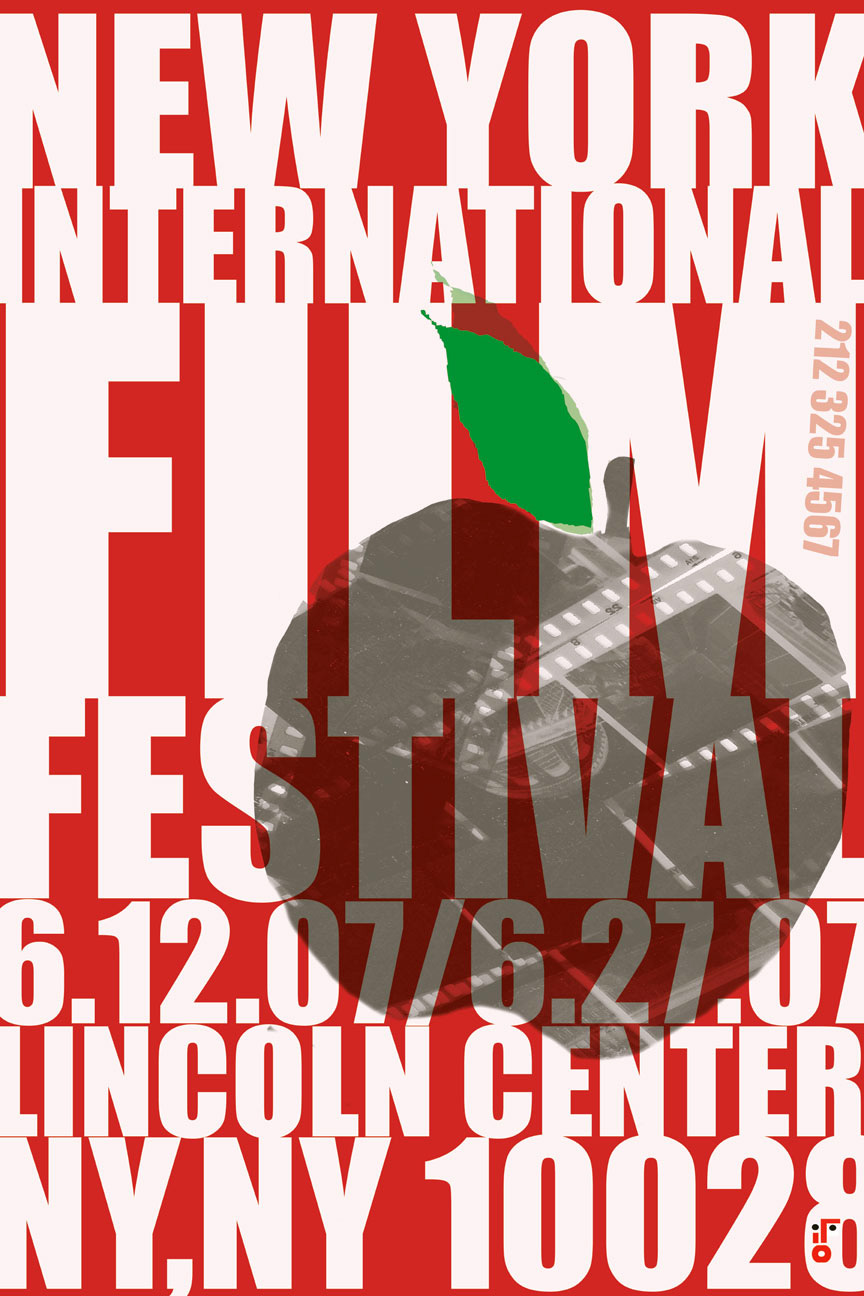
A bit too rough and ready for me- but I like the typeface engulfing the page- looks really high-impact and would certainly be eye-catching to a passer-by.


Love how mad this really is. Sure, it's appropriate for the Futuristic Film Festival, but perhaps not with The Wes Anderson Film Festival (films of which have more than a little tendency to flirt with 1970's stylings)- fun use of hand-rendered illustration, not very commonly seen in contemporary graphic design, so pretty refreshing.


Quite Saul Bass like in it's paper-cut like style. Fun colours and an engaging way to attract attention with the type part of the illustrative design.


Again- love the colour palette. So simple in design, but the vibrancy really makes it stand out to be something quite extraordinary. I don't think it would be doable considering the time (but I'll definitely have a go!), but a style like this would make a brilliant poster/programme design cover.


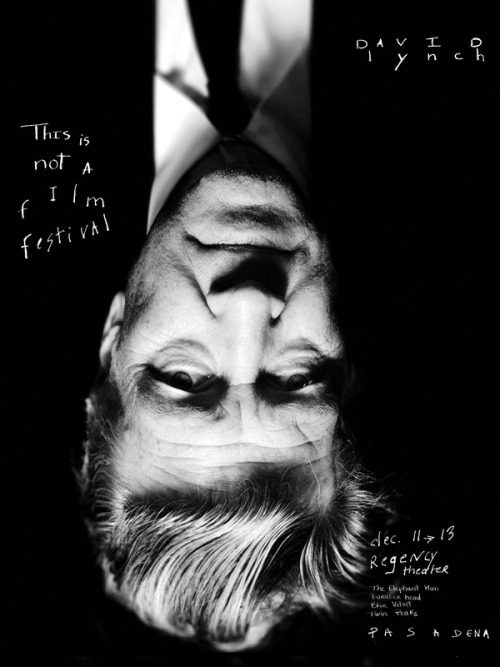
Perhaps my favourite poster from the blog (might be to do with a Lynchian love?)- fun and simple composition- the type also creating a sense of playfulness and the (CLICHE ALERT!) "thinking outside the box" that Lynch is so well known for in his films- yet the black and white helps to ensure the design is kept minimal and sophisticated.

Saturday, 12 November 2011

Design Production for Print//Film School Mailing List.


Today I had a bit of a brainwave- when considering my mailshot items, I knew that my existing mailing list was both a) far too minimal and b) far too "elite". Whilst I had purely aimed my focus at those already in the film industry, and critics, I wasn't truly looking to my target audience- film lovers, and particularly young film lovers- those who would be most attracted to the substance and stylings of Wes' films. Therefore, I decided to take a look at film schools and courses around the UK- and could address to these institutes a mailshot each in order to promote to a far wider market (all of their enrolled students)- whilst still keeping costs down 
(if this brief were to be live).
More information about my mailshot designs, and my design production for print project can be found on my Design Practice blog.


Never did I think I would return- but I came back to the UCAS website- a great way for filtering information about specific University courses, and was really pleased by the results I sourced. The addresses below are new additions to my student-based mailing list.
In some instances I have also considered joint courses such as psychology, drama, and screenwriting, as I feel these are all integral interests to really appreciate a Wes Anderson film.


Film & Digital Media
Accrington & Rossendale College

Broad Oak Road
Accrington
Lancashire
BB5 2AW


Film Studies
Anglia Ruskin University

Bishop Hall Lane
Chelmsford
Essex
CM1 1SQ


Writing & Film Studies
Anglia Ruskin University

Bishop Hall Lane
Chelmsford
Essex
CM1 1SQ


Film Production
The Arts University College at Bournemouth (Formerly Arts Institute at Bournemouth)

Wallisdown
Poole
Dorset
BH12 5HH


Film Studies

Bangor University
Bangor
Gwynedd
LL57 2DG


Film & Screen Studies
Bath Spa University

Newton Park
Newton St Loe
Bath
BA2 9BN


Film, Production & Technology
Birmingham City University

Perry Barr
Birmingham
B42 2SU


Film Studies
The University of Bradford

Richmond Road
Bradford
West Yorkshire
BD7 1DP


Film Studies
University of the West of England, Bristol

Frenchay Campus
Coldharbour Lane
Bristol
BS16 1QY


Film Studies & Screen Writing
University of the West of England, Bristol

Frenchay Campus
Coldharbour Lane
Bristol
BS16 1QY


Film & Television Studies
Brunel University

Uxbridge
Middlesex
UB8 3PH


Film & TV Production
Buckinghamshire New University

Queen Alexandra Road
High Wycombe
Buckinghamshire
HP11 2JZ


Film Production
University of Central Lancashire
Preston
Lancs
PR1 2HE


Film & Television Screen Writing
University of Central Lancashire
Preston
Lancs
PR1 2HE


Film Production
University for the Creative Arts
Falkner Road
Farnham
Surrey
GU9 7DS


Digital Film Production
Croydon College
College Road
Croydon
CR9 1DX


Film & Television Production
University of Cumbria
Fusehill Street
Carlisle
Cumbria
CA1 2HH


Film Studies
De Montfort University
The Gateway
Leicester
LE1 9BH


Film Studies
University of Derby
Kedleston Road
Derby
DE22 1GB


 Philosophy & Film
University of Dundee
Nethergate
Dundee
DD1 4HN


Philosophy & Film Studies
University of East Anglia
Norwich
NR4 7TJ


Film Studies
Edge Hill University
Ormskirk
Lancashire
L39 4QP


Film Studies
The University of Essex
Wivenhoe Park
Colchester
Essex
CO4 3SQ


Film Studies
University of Exeter
Laver Building
North Park Road
Exeter
Devon
EX4 4QE


Film
University College Falmouth
Woodlane
Falmouth
Cornwall
TR11 4RH


Film Studies
University of Glamorgan, Cardiff and Pontypridd
Enquiries and Admissions Unit
Pontypridd
CF37 1DL


Film
The University of Gloucestershire
Park Campus
The Park
Cheltenham
GL50 2RH


Film Studies
University of Greenwich
Greenwich Campus
Old Royal Naval College
Park Row
London
SE10 9LS


Film & TV Production
University of Hertfordshire
University Admissions Service
College Lane
Hatfield
Herts
AL10 9AB


Film Studies
The University of Hull
Cottingham Road
Hull
HU6 7RX


Film Studies
The University of Kent
Information
Recruitment & Admissions
Registry
University of Kent
Canterbury
Kent
CT2 7NZ


Film Studies
King's College London (University of London)
Strand
London
WC2R 2LS


Film Making
Kingston University
Student Information & Advice Centre
Cooper House
40-46 Surbiton Road
Kingston upon Thames
KT1 2HX


Film Studies
Kingston University
Student Information & Advice Centre
Cooper House
40-46 Surbiton Road
Kingston upon Thames
KT1 2HX


Film Studies
Lancaster University
The University
Lancaster
Lancashire
LA1 4YW


Film Studies
Leeds Trinity University College (Formerly Leeds Trinity and All Saints)
Brownberrie Lane
Horsforth
Leeds
LS18 5HD


Film & Moving Image Production
Leeds Metropolitan University
Course Enquiries Office
City Campus
Leeds
LS1 3HE


Film Studies
Liverpool John Moores University
Kingsway House
Hatton Garden
Liverpool
L3 2AJ


Creative Writing & Film Studies
Liverpool John Moores University
Kingsway House
Hatton Garden
Liverpool
L3 2AJ


Film Studies
London South Bank University
103 Borough Road
London
SE1 0AA


Film & Television Studies
London Metropolitan University
166-220 Holloway Road
London
N7 8DB


TV & Film Production
The Manchester College
Openshaw Campus
Ashton Old Road
Openshaw
Manchester
M11 2WH


Filmmaking
The Manchester Metropolitan University
Admissions Office
All Saints (GMS)
All Saints
Manchester
M15 6BH


Film
Middlesex University
The Burroughs
London
NW4 4BT


Film & Video
University of Wales, Newport
Admissions
Lodge Road
Caerleon
Newport
NP18 3QT


Film & Television Studies
The University of Nottingham
The Admissions Office
The University of Nottingham
University Park
Nottingham
NG7 2RD


Film Studies
Oxford Brookes University
Admissions Office
Headington Campus
Gipsy Lane
Oxford
OX3 0BP


Film
Plymouth College of Art (formerly Plymouth College of Art and Design)
Tavistock Place
Plymouth
PL4 8AT


Film & Media Production
Plymouth College of Art (formerly Plymouth College of Art and Design)
Tavistock Place
Plymouth
PL4 8AT


Film Studies
University of Portsmouth
Academic Registry
University House
Winston Churchill Avenue
Portsmouth
PO1 2UP


Film & Media
Queen Margaret University, Edinburgh
Queen Margaret University Drive
Edinburgh
EH21 6UU


Film Studies
Queen Mary, University of London
Queen Mary
University of London
Mile End Road
London
E1 4NS


Film Studies
Queen's University Belfast
University Road
Belfast
BT7 1NN


Digital Film Production
Ravensbourne
6 Penrose Way
London
SE10 0EW


Film & Theatre
The University of Reading
PO Box 217
Reading
RG6 6AH


Film
Roehampton University
Erasmus House
Roehampton Lane
London
SW15 5PU


Film & Television Studies with Philosophy
Royal Holloway, University of London
Royal Holloway
University of London
Egham
Surrey
TW20 0EX


Film Studies
The University of Salford
Salford
M5 4WT


Digital Film Making
SAE Institute
Littlemore Park
Armstrong Road
Oxford
OX4 4FY


Film Studies
Sheffield Hallam University
City Campus
Howard Street
Sheffield
S1 1WB


Film
University of Southampton
Highfield
Southampton
SO17 1BJ


Film & Philosophy
University of Southampton
Highfield
Southampton
SO17 1BJ


Film
Southampton Solent University
East Park Terrace
Southampton
Hampshire
SO14 0RT


Film Studies- Philosophy
University of St Andrews
St Katharine's West
16 The Scores
St Andrews
Fife
KY16 9AX


Film
University Campus Suffolk (UCS)
Waterfront Building
Neptune Quay
Ipswich
Suffolk
IP4 1QJ


Film Studies
University of Surrey
Stag Hill
Guildford
Surrey
GU2 7XH


Film Studies with Creative Writing
University of Surrey
Stag Hill
Guildford
Surrey
GU2 7XH


Film Studies
University of Sussex
Undergraduate Admissions
Sussex House
University of Sussex
Brighton
BN1 9RH


Film & Television
University of the Arts London
272 High Holborn
London
WC1V 7EY


Film
The University of West London
St Mary's Road
Ealing
London
W5 5RF


Film Studies
The University of Warwick
Coventry
CV4 8UW


Film & Television Production
University of Westminster
2nd Floor
Cavendish House
101 New Cavendish Street
London
W1W 6XH


Film Studies
University of Wolverhampton
Admissions Unit
MX207
Camp Street
Wolverhampton
West Midlands
WV1 1AD


Film Studies
University of Winchester
Winchester
Hants
SO22 4NR


Film & Television Production
The University of York
Admissions and UK/EU Student Recruitment
University of York
Heslington
York
YO10 5DD


Writing, Directing & Performance
The University of York
Admissions and UK/EU Student Recruitment
University of York
Heslington
York
YO10 5DD


Film & Visual Culture
The University of Aberdeen
University Office
King's College
Aberdeen
AB24 3FX
 
 
77 MAILSHOTS TO SEND (phew)... would be an interesting test to work out costs (post print) to see whether this would be financially viable in terms of seating and sales at the Hyde Park Picture House- whether a profit could still be made on ticket sales, etc.