Showing posts with label Urban Beekeeping. Show all posts

Sunday, 23 September 2012

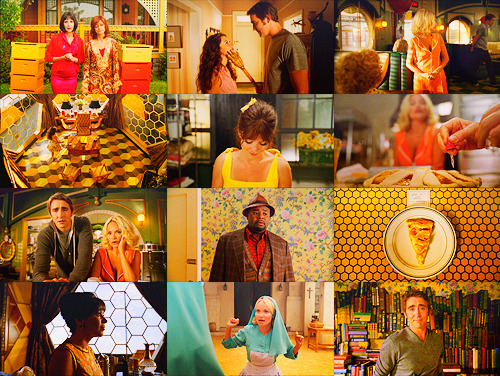
Design Practice III//Negotiated Briefs//Urban Beekeeping & Popular Culture (Pushing Daisies).


Image Source

In terms of a little background information as to the conception of the urban beekeeping brief that I have written for myself, I first became interested in the practice of beekeeping in a serious way in 2007, funnily enough, through a television programme, 'Pushing Daisies', a quirky, colourful, detective drama series on American broadcasting channel, ABC, in which, amongst many characters, actress Anna Friel played Charlotte 'Chuck' Charles, a beekeeper and the love of lead character, Ned's life, bought back from the dead (quirky with a capital 'Q').

Although from very simple beginnings, this "glamorisation" of beekeeping gave me interest to learn more, and discover about these hard-working and, often, misunderstood, gentle animals. 

From my own initial insight into the world of beekeeping (and, in particular, urban beekeeping), one of my main aims from the project is to promote beekeeping to a much wider audience and to add a little "glamour" through high-end, considered branding and promotion which will help to teach and engage others and help to popularise the practice even more so that it has in the past few years.

After extensive research into the practice, and the curent market, I hope to swiftly move on to concept and design development, as well as completing my written brief- all evidence of which can be found on both my Design Context and Design Practice blogs.


Image Source


Image Source


Image Source


Image Source


Image Source


Design Practice III//Negotiated Briefs//Urban Beekeeping History.


For one of my ten negotiated briefs throughout Design Practice III, and, in particular, one of my priority briefs, is to design a starter kit for Urban Beekeeping, as something I am particularly interested in, and I feel that I could get a lot from in terms of a brief/project outcome with both research and items to be produced, such as a branded hive/hive utensils (such as gloves), along with necessary legality documentation, an information pack, etc.
Although I know a little about the practice of Urban Beekeeping, I've decided to start from the very initial research basics, and hopefully aspire to "become a professional for a day" and learn more about the practical side of beekeeping as the weeks go on throughout the course of the project.

Written below is sourced information from the independent Urban Beekeeping Wikipedia source page.

//
URBAN BEEKEEPING

Urban beekeeping is the practice of beekeeping in an urban environment. It has become popular in cities such as New York and London, which saw a 220% increase in beekeepers between 1999 and 2012. And the practice has been recently made legal in many American cities, including New York.
Unperturbed by urban pollutants, some say bees from city apiaries are "healthier and more productive than their country cousins". As cities have limited greenspaces, however, the increasing popularity of the hobby may lead to lower honey yields as has happened in London and New York. Another problem created by a surfeit of bees is swarming, when a queen leaves an overcrowded colony with a retinue of workers to start her own.
The number of bee hives varies greatly from city to city, and official counts may be inaccurate; a high proportion of hives are not registered. In 2012, an estimated 75% of London apiaries were operated without license. That same year about half of New York hives were thought to be unlicensed. An estimated 3,200 apiaries exist in London, 400 in New York, and at least 100 in Toronto.
Urban beekeeping can be considered part of the local food movement.
In some cities, beekeeping is done by organizations as well as individuals. Many are hotels. In London, bees are kept at department store Fortnum & Mason, Lambeth Palace, the London Stock Exchange, the Natural History Museum, and at the Royal Lancaster Hotel, etc. Hives once stood atop the Bank of England as well. In New York, the InterContinental The Barclay Hotel, the Waldorf-Astoria Hotel, and the York Prep School all keep bees. In Paris, bees are found at the Mandarin Oriental Hotel and OpĂ©ra Garnier. Toronto counts the Fairmont Royal York (in fact, the Fairmont Hotel Group keeps bees at 18 of its properties), the Opera House, andCasa Loma as host to apiaries. In Denver, the Brown Palace Hotel has its own hive, and The White House is one place bees are kept in Washington DC.

Tuesday, 18 September 2012

Design Practice III//Negotiated Briefs//Urban Beekeeping.


For one of my ten negotiated briefs that I intend to write, and work upon throughout the first half of this academic year, is creating an Urban Beekeeping starter kit. With the population of honey bees in decline in Britain over the last few years, and with a natural interest in bees, and the aspiration to one day own my own hive, I felt this would be a great opportunity to research and learn about more about the practice of beekeeping, as well as promoting it to a much wider audience.

Throughout the brief I want to create a publication guide about urban beekeeping to demonstrate the simplicity and ease of owning a hive, whenever you may live, and whatever space you have accesible to you, as well as creating a starter pack of branded materials for all aspiring beekeepers, such as the hives, smokers, smocks, gloves, etc.

More research will be posted in the near future on my Design Context blog, whereas all design developments for the brief, along with the written brief itself, will be found on my Design Practice blog.